


There is a certain kind of career that refuses to be defined by one chapter.
Beverly Osu is building that kind.
From the fashion and music-video scene that first introduced her to Nigerian pop culture, to becoming a formidable screen actress, fashion figure and increasingly outspoken voice on mental health and self-worth, Beverly’s story is ultimately about evolution. She has spent years moving beyond the image people first attached to her, steadily replacing perception with substance, range and intention.
Born in Delta State and raised in Lagos, Beverly grew up surrounded by a strong Catholic influence and, at one point, genuinely imagined herself becoming a Reverend Sister. She attended the Daughters of Divine Love Juniorate in Enugu and has described herself as a meticulous, expressive child who loved drawing, writing stories and creating. Years later, that instinct for storytelling would find a different stage.
Before the Roles, There Was the Image
Long before Nollywood began giving her complex characters to inhabit, Beverly understood the power of an image.
She emerged as one of Nigeria’s most recognisable models and video vixens, becoming part of the visual language of an era in Nigerian music. Her appearances in videos including Ice Prince’s Oleku, Terry da Rapman’s Boys Are Not Smiling, Djinee’s Overkilling and Kizz Daniel’s Madu made her face familiar far beyond the modelling world.
In 2011, that early work earned her the Dynamix All Youth Awards’ Model of the Year and Nigerian Top Video Vixen honours.
But Beverly was never content to remain a face in someone else’s story.
From Being Seen to Being Heard
Her official transition into acting came with Curse of the Seven, opening the door to a career that would eventually take her from commercial cinema to internationally distributed productions.
Her filmography has grown across genres and platforms, including Chief Daddy, Nneka the Pretty Serpent, Progressive Tailors Club, Unintentional, I Do Not Come to You by Chance, Love Notes, A Ghetto Love Story and The Serpent’s Gift. She has also appeared in productions such as Jenifa’s Diary and Òlòtūré: The Journey.
Then came Peju.
In Òlòtūré, Beverly delivered one of the performances that would significantly reshape how audiences viewed her. The Netflix story demanded vulnerability, emotional intensity and an ability to disappear into another person’s reality. For Beverly, the experience went beyond simply playing a character.
She has spoken openly about how deeply she immersed herself in the role and how difficult it became to separate herself from Peju after filming. In 2025, she revealed that the experience left her dealing with an identity crisis and depression for several months. That experience became another turning point, deepening her commitment to conversations around mental health.
The Art of Becoming
Beverly’s approach to acting is intensely personal.
She has described her process as one of complete openness—allowing herself to understand a character emotionally rather than simply performing lines. In a recent conversation with The Culture Custodian, she explained that characters can linger long after filming, sometimes requiring her to consciously find her way back to herself.
That emotional investment has become part of what makes her performances compelling. She does not seem interested in simply appearing in a film; she wants the work to leave something behind.
Her more recent projects show that continued expansion. The Serpent’s Gift arrived in 2025, while Call of My Life, directed by Dammy Twitch, brought her into a warmer, feel-good romantic story in 2026. She has also continued to build momentum through her partnership with talent-development company First Of My Kind, with a renewed focus on positioning her career for larger opportunities across Africa and beyond.
More Than the Screen

Away from acting, Beverly has maintained a strong relationship with fashion, beauty and commercial culture.
Her early brand portfolio included Prestige Cosmetics and Ivie Hair, with the latter naming her as its face in 2014.
But fashion, for Beverly, appears to be more than an endorsement opportunity. It is another language.
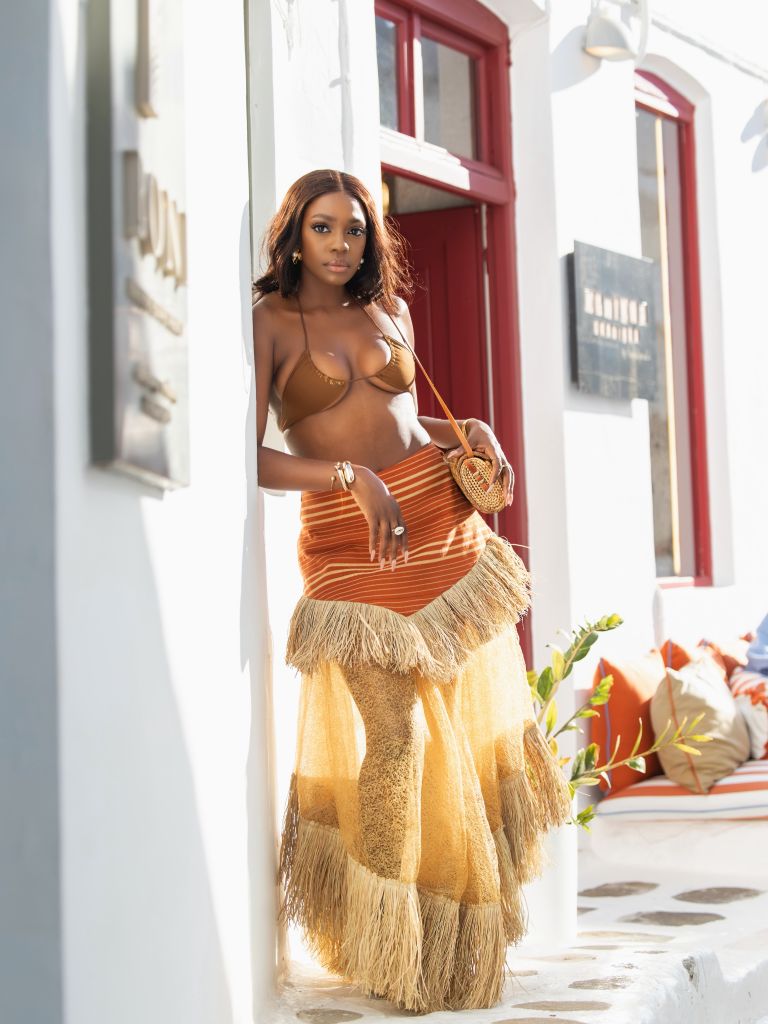
Her red-carpet appearances, editorials and personal style have repeatedly positioned her as someone comfortable treating fashion as part of her artistic identity. At the 2026 premiere of Call of My Life, for instance, she arrived in a striking teal Sama Woman creation that became one of the evening’s standout fashion moments.
She has also been willing to speak about what she believes the industry should represent. In 2025, her criticism of the direction of the AMVCA red carpet sparked conversations about whether African award ceremonies are giving enough attention to filmmaking and craft alongside spectacle.
Finding Purpose in the Noise
Perhaps the most interesting evolution in Beverly Osu’s story is the one happening away from cameras.
Mental health, boundaries, self-worth and personal growth have increasingly become part of her public voice. She has spoken about the importance of protecting one’s peace, understanding oneself and refusing to measure personal value through public validation.
That perspective feels especially significant for someone whose career has unfolded under intense public attention.
Beverly has spent years being interpreted by other people—through headlines, images, characters and assumptions. Today, she seems increasingly interested in doing the interpreting herself.
And perhaps that is the real evolution.
The Next Chapter Is Hers
Beverly Osu is no longer simply the model, the video vixen, the actress or the public personality people think they remember.
She is the sum of all those chapters—and everything she has learned between them.
There is the girl who once imagined a life in a convent, the young creative who found expression through modelling, the face that became familiar through Nigerian music, the actress who disappeared into Peju, the woman who openly confronted what that experience did to her, and the artist now demanding more intention from the work attached to her name.
Her career is becoming less about proving that she can remain visible and more about deciding what that visibility should mean.
For Beverly Osu, the narrative is no longer something to be handed to her.
She is writing it herself.


Proudly powered by Creative Culture